
Chimney Rock is one of the most visually striking landmarks in Nebraska, standing out amongst other erosional remnants around it due to its unique shape. It not only served as a profoundly recognizable landmark for easterners traveling into the western U.S., but foretold of the unfamiliar and unnerving landscape these voyagers were entering as well.
“It’s unique … whereas (the Scotts Bluff National Monument and Courthouse Rock) are big edifices, Chimney Rock is a spire,” said Chimney Rock State Historic Site Manager Loren Pospisil.
Spires are considered a rare and advanced stage of erosional remnant, representing the final phase of weathering before a geological formation disappears entirely. In the distant past, Chimney Rock was likely part of a larger mesa or bluff, but it has been withstanding erosional forces so long that it has been reduced to the 300-foot-tall jagged point that stands today.
People are also reading…
Pospisil said that the landmark’s shape helps visitors clearly identify the various sedimentary layers of sandstone, siltstone and volcanic ash that make up not just Chimney Rock, but a great swath of the area’s prominent features.
“The entire region is made up of these layers,” Pospisil said. “Those horizontal layers are all sedimentary stuff, stuff that's been deposited from other places. A lot of it was stuff that was sloughed off of the Rockies when they were pushed up.”
Akin to its neighboring landmarks, Chimney Rock has withstood total erosion over its 25 million years of existence thanks to a hard “cap rock” layer on top, protecting the much softer materials below. Though this doesn’t mean that the feature is entirely immune to deterioration.
According to the California Trail Interpretive Center, emigrants in the area journeying westward may have witnessed an even grander structure. From photographs taken during the mid-nineteenth century, it’s clear that the feature used to have a taller point that may have been eroded away, or was the victim of a lightning strike.

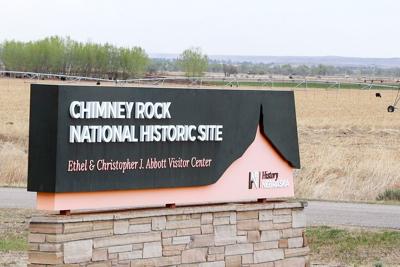
A sign out front welcomes visitors to Chimney Rock and its visitors center on May 3.
Due to its memorable appearance, Chimney Rock was the most-mentioned landmark on the trail, according to a survey of over 300 diaries.
One such diary, recorded in part on the National Park Service website, captured the awe of one Elisha Perkins as he witnessed the monument in 1849.
“No conception can be formed of the magnitude of this grand work of nature until you stand at its base & look up,” Perkins wrote. “If a man does not feel like an insect then I don't know when he should.”
This sense of reverence, mixed with trepidation, was common among all who traveled past Chimney Rock on the Oregon, Mormon and California Trails, among others. Pospisil said that the landmark was of significance to them not only due to its usefulness in marking their progress, but also its role as a symbolic gateway into unfamiliar territory.
“It's this landmark that symbolizes their world is changing for them,” Pospisil said. “In the east, with more moisture, more rainfall, everything's greener, better farmland. They're going into the west, where it's drier, thinner topsoil. … This very dry, sandstone type of stuff was new and unique to them. It was stuff that they hadn't seen before.”
On the first sections of emigrants’ travel along the trails, significant landmarks might have been water features, trees or unique vegetation. Coming up to Chimney Rock, those familiar elements dwindled, as well as travelers’ preparedness to survive in the harsh new landscape.

Chimney Rock, comprised of multiple layers of sandstone, siltstone and volcanic ash, stands tall on May 3.
“They had to burn prairie wood or buffalo chips instead of actual wood,” Pospisil said. “The wagon wheels (were) shrinking (due to the rougher ground), and all of a sudden, the metal hubs don't stay on anymore.”
“They're also going up slowly,” Pospisil said. “They've gone up — probably from the eastern part of Nebraska to here, a good 2,000 feet — and they don't even know they're going up, and they're going to go up farther as they go west.”
Over three decades of travel along the major westward emigrant trails, Chimney Rock’s uniqueness marked it as a triumphant measure of progress for some, a foreboding spire representing a tough landscape up ahead for others, and a geological wonder of a vast new territory for all.
“It might be a curiosity to them to look at, but … the geology is affecting their life,” Pospisil said.