
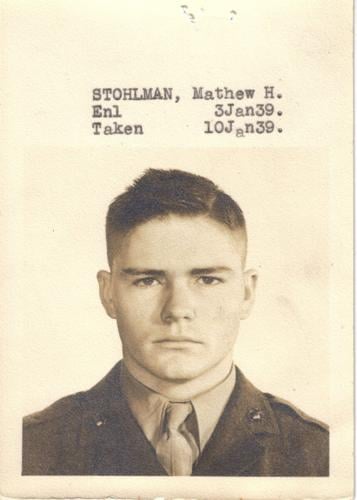
Before the Japanese attack on Pearl Harbor on Dec. 7, 1941, Pvt. Mathew Stohlman was living in relative luxury as a U.S. Marine stationed in China.
The Louisville, Nebraska, native and youngest of 14 children who was on born Oct. 30, 1917, found the $77 monthly salary he made as a Marine (equivalent to over $1,800 today) could go further in China than it did for his counterparts stationed in the United States and Caribbean.
Kater Miller, a curator with the National Museum of the Marine Corps, noted Stohlman, who was deployed to China in March 1940, and the Marines he was stationed with in Tientsin — near modern-day Beijing — could take advantage of all the lifestyle amenities offered only in the world’s largest cities.
“There were casinos, dance clubs, jazz clubs and huge sporting grounds,” Miller said.
People are also reading…
There were also cheap yet high-quality goods to go along with cheap yet high-quality services.
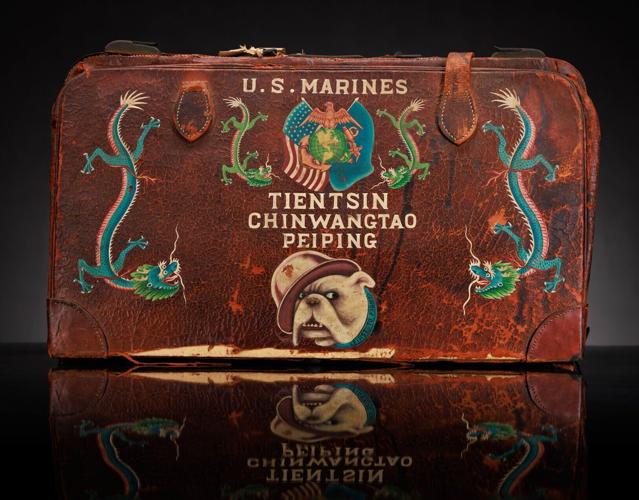
No more was that symbolized for Stohlman than the leather valise he bought. Stohlman then paid to have the small bag customized with a depiction of the Devil Dog — a nickname the Marines acquired from a description by German soldiers in World War I — and four Chinese dragons to go along with the stitching of the Chinese cities he was based in and the Eagle, Globe and Anchor insignia of the Marines.
“This is probably not something that an enlisted Marine stateside would have been able to afford in this time period,” Miller said.
The comfortable lifestyle Stohlman and his fellow Marines stationed in China came to an end as soon as the Japanese military attacked Pearl Harbor.
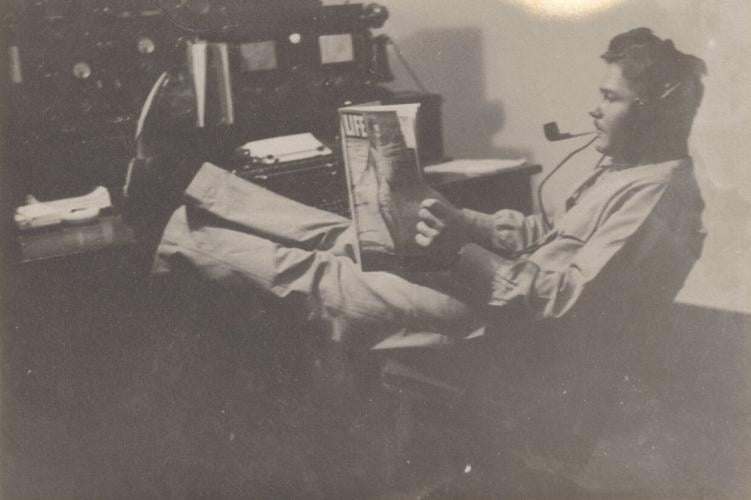
The moment the Japanese launched the surprise attack, Stohlman, who worked in the Marines as a radio operator, went to the three-story radio station building on the military base to get the station up and running for the day.
Stohlman knew something was off when the station building was unusually quiet, said Susan Stohlman Salazar, the youngest of four children of Stohlman and his wife, Lily Kimball. He then saw why as he looked out the building’s third-story window and saw the Japanese forces.
“As the light came on, he could see on the street that they were completely surrounded. They had been surrounded since the wee hours of the morning,” Stohlman Salazar said in a recent interview.
Stohlman and his fellow service members were forced to trade the fine dining, recreation and shopping lifestyle to one of eventual malnourishment, disease and brutality from their Japanese captors.
That latter lifestyle lasted nearly four years and saw Stohlman held prisoner in three different prisoner of war camps operated by the Japanese military in China: Tientsin, Woosung and finally Kiangwan.
One silver lining for Stohlman was that the Japanese allowed Stohlman and his fellow Marines to put their baggage into storage. A Swiss storage company agreed to hold Stohlman’s ornate bag in a Chinese warehouse for the war’s duration.
The Pearl Harbor attack wasn’t the first instance of Japanese military aggression toward the Americans. In December 1937, as Miller wrote in the Marine Corps University Press, the Japanese bombed the U.S. Navy river gunboat USS Panay. The bombs sank the gunboat and killed three American soldiers.
The bombing came five months after Japanese forces clashed with the Chinese military in a battle known as the Marco Polo Bridge incident — a battle that Miller wrote many historians agree was the true start to World War II.
The United States considered militarily responding to the Panay bombing but dropped that idea after the Japanese government apologized and agreed to pay for the destroyed boat, Miller wrote.
Throughout his years in captivity, Stohlman meticulously kept a diary. At first, Stohlman Salazar said, he and his fellow Marines were optimistic they would be treated as diplomatic personnel and be released back into the arms of the United States government.
But the captives got discouraged as they got hungrier. Occasionally, the Japanese allowed the captives to write and send letters to their families via the Swiss Red Cross headquarters in Switzerland. However, it took roughly 10 months for the letters to be delivered, Miller wrote.
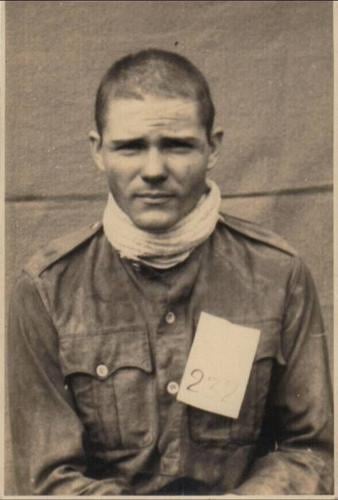
Twice in 1943, Stohlman wrote letters to his parents asking for food to be sent to him. Although Stohlman wrote he was in good health, a contemporary photo of him showed he was malnourished.
The former Louisville Weekly Courier in Nebraska published an article informing its readers how to send packages to Stohlman.
Stohlman Salazar said her father lost about 60 pounds from his muscular 185-pound frame as he and his fellow captives subsisted on “small, meager bits” of rations that included rocks being embedded in the rice they received.
“You’d have to break your teeth on it,” Stohlman Salazar said.
Stohlman and his fellow captives were further demoralized by the work their Japanese captors made them do, which included polishing anti-aircraft shells the Japanese would then use against the Americans. Even as they were forced to prime the Japanese anti-aircraft shells, Stohlman and his comrades found ways to circumvent their captors.
“They would polish them really thin and they would fantasize that they were blowing up on them,” Stohlman Salazar said.
She added her father said he and his fellow captives also passed time by fantasizing about the food their wives and girlfriends had cooked for them.
Even in those darkest of times, there were glimmers of hope.
Twice, the Japanese would take Stohlman to speak on AM radio broadcasts with the intention of him spreading Japanese propaganda. One of those AM broadcasts was heard by a woman, who Miller identified as W. N. Tappert, in Mojave, California. Although Tappert couldn’t decipher Stohlman’s full name, she caught his first name and sent a message to Louisville Weekly Courier.
The newspaper, Miller wrote, figured out Stohlman made the broadcast and published his message asking for food, candy and tobacco. Stohlman said in his broadcast he had received two packages from the Red Cross but none from his parents.
In another glimmer, near the end of the war in July 1945 as the Japanese military was being routinely bombed by the Americans, Stohlman and his fellow captured Marines were forced to wear old Japanese military uniforms when the American planes did a strafing run, Stohlman Salazar said. One pilot who was on the run recognized the captives for what they were and tipped the plane’s wings, acknowledging their American allegiance.
Stohlman Salazar said that event gave Stohlman and the captured Marines a significant morale boost.
“He felt like they were seen,” Stohlman Salazar said.
It would take another two months before Stohlman and the surviving Marines and sailors in China were finally released from captivity on Sept. 5, 1945 — three days after Japan formally surrendered. Throughout Stohlman's time in captivity, the Marine Corps promoted him up to the rank of sergeant.
News of Stohlman’s liberation, along with the liberation of two other Nebraskans who were prisoners of war, was reported in the evening edition of the Sept. 19, 1945, issue of The World-Herald.
Considering the brutal conditions imposed upon them, the rate of survival among the Marines and sailors who had been captured in north China in December 1941 was remarkable. Miller wrote that out of the 204 Marines and sailors captured, 184 survived and came home.
One theory relayed by Miller for the captives’ high survival rate could have been the better physical shape the Marines were in before their capture compared to service members of other military branches. Another theory Miller shared is that prisoners of war captured early in the war were treated better in the camps compared to those who were captured later.
“You’re going to have more access to food (and) possibly a little bit more medicine — not that they were giving these guys a whole bunch of medicine,” Miller said.
Miller also said prisoners of war who were in China or Japan had greater access to Red Cross packages than those who were on isolated islands, where even many Japanese soldiers were starving because of the Japanese navy being decimated and unable to resupply those troops.
“If the army and navy of Japan isn’t getting fed, you know that prisoners of war definitely aren’t,” Miller said.
Stohlman Salazar said her father believes he and the others fared better than the other Japanese prisoners of war because they had grown accustomed to Japanese control of China before their capture.
“They were so accustomed to the way (Japanese) did things. Even though they were beaten and went without food and all that kind of stuff, they just seemed to be able to get around it better,” Stohlman Salazar said. “My dad used to say all the time that’s the way they were trained.”
Even though Stohlman survived, he was found to be in a horrifying condition. According to Stohlman Salazar, her father’s diseases and ailments included but were not limited to:
• Malnutrition
• Malaria
• Hernia
• Chronic sore throat
• Loss of right kidney function due to beatings
• Rapid heartbeat
• Hearing loss
• Ulcers
• Dysentery
• Dental problems
• Anxiety and depression
• Burns on hands and feet due to working with molten iron
Understandably, Stohlman had nightmares stemming from his captivity for years after he was released. After his liberation, Stohlman visited his parents and family in Nebraska before he went back to live and work in Los Angeles, where he had been before his deployment to China.
It took Stohlman Salazar and her three siblings decades to understand exactly what their father had been through, though they began picking up on signs when they were children.
“When we were little, it came in the form of 'Eat everything on your plate. When I was a POW, I had to eat worms,’” Stohlman Salazar recalled. “When you were a little kid, you don’t really understand. We knew it was bad.”
Family helped Stohlman cope by giving him a stable life, which is “all he wanted,” Salazar Stohlman said. Stohlman eventually recovered further from his ordeals thanks to reunions with his fellow captives beganning in the late 1970s and veteran support services that became emphasized in the aftermath of the Vietnam War.
Stohlman lived a long, productive life after the war until his death at the age of 86 on April 7, 2004.
About a year after he was liberated, Stohlman received a postcard informing him that his leather valise from the Swiss storage warehouse in China was waiting for him at Los Angeles Union Station.
While many of the valuables from the bag were stolen, including the handmade robes he bought for his family, Stohlman found a pair of ice skates he bought before his capture inside as well as a diary he hid in the bag’s lining.
For 50 years, Stohlman Salazar estimated, her father had the valise on his garage shelf before he eventually gave it to her.
Three years after her father died in 2007, Stohlman Salazar, along with her mother and Stohlman’s wife Lily, donated the valise to the National Museum of the Marine Corps.
Stohlman’s bag is part of a special exhibit at the National Museum of the Marine Corps in the Washington, D.C., suburb of Triangle, Virginia. The exhibit is celebrating the 250th anniversary of the formation of the United States Marine Corps.
“I lived in a really hot area at the time and I thought, 'Well, this is just going to deteriorate and it’s too beautiful,’” Stohlman Salazar said. “I’m just glad it’s being preserved.”
Our best Omaha staff photos & videos of May 2026
Greg Abel, CEO of Berkshire Hathaway, poses for photos with shareholders during the 2026 Berkshire Hathaway Shareholder Shopping Day at the CHI Health Center in Omaha on Friday, May 1, 2026.
Omaha Skutt's Pierce Havens (1) fails to stop Omaha Roncalli's Will Preston (16) from attempting a shot on goal during the first half of a high school boys soccer district final match in Omaha, on Friday, May 8, 2026.
Fans celebrate in the foreground as Nebraska's Will Jesske (13) rounds the bases after hitting a grand slam during the third inning of a college baseball game against Iowa at Haymarket Park, in Lincoln on Saturday, May 9, 2026.
Nebraska's Dylan Carey (15) autographs a baseball for a young fan after the Huskers defeated Iowa, 15-11, at Haymarket Park, in Lincoln on Saturday, May 9, 2026.
Georgetown's AJ Solomon (42) throws to first base after tagging out Creighton's Nick Venteicher (12) at second base during the seventh inning of a college baseball game at Charles Schwab Field, in Omaha on Sunday, May 10, 2026.
Omaha firefighters battle a semi trailer that caught fire near 78th and I Streets in Omaha, on Monday, May 11, 2026.
Numerous law enforcement officers are in front of 1915 Washington St.. after a shooting that left a man dead and a Douglas County sheriff's deputy injured in Omaha, on Friday, May 8, 2026.
Millard West’s Hudson Brubaker runs in the 4x100 meter in the Metro Conference track finals at Omaha Burke in Omaha, on Wednesday, May 6, 2026.
Elkhorn South’s Ava Hamilton holds her dog, Nova, in between events at the Metro Conference track finals at Omaha Burke in Omaha, on Wednesday, May 6, 2026.
Nebraska's Tucker Timmerman (32) pitches during the ninth inning of a college baseball game against Iowa at Haymarket Park, in Lincoln on Sunday, May 10, 2026.
Nebraska players react as they are announced as the four seed during the NCAA softball tournament selection show at Bowlin Stadium, in Lincoln on Sunday, May 10, 2026.
Omaha firefighters battle a semi trailer that caught fire near 78th and I Streets in Omaha, on Monday, May 11, 2026.
A Douglas County sheriff's deputy is seen near 1915 Washington St.. after a shooting that left a man dead and a Douglas County sheriff's deputy injured in Omaha, on Friday, May 8, 2026.
Numerous law enforcement officers are near 1915 Washington St.. after a shooting that left a man dead and a Douglas County sheriff's deputy injured in Omaha, on Friday, May 8, 2026.
Dewayne Wabasha, left, and Terri Grant speak about Ashleigh Wabasha, who was murdered in 2022 during an Murdered and Missing Indigenous Peoples Awareness event at the Gene Leahy Mall in Omaha, on Tuesday, May 5, 2026.
Omaha firefighters battle a fire at a duplex at 4717 S 19 St. in Omaha, on Tuesday, May 12, 2026.
Omaha firefighters battle a fire at a duplex at 4717 S 19 St. in Omaha, on Tuesday, May 12, 2026. Jason Brilz
Omaha Skutt players mob Omaha Skutt’s Charlie Diederich (14) after he had a walk-off two-run single during a Nebraska Class B quarterfinal boys state baseball tournament game, at Werner Park in Papillion, on Saturday, May 16, 2026.
A storm that caused a tornado warning is seen south of Dodge Street as severe weather hit Omaha, on Sunday, May 17, 2026.
Zaire Mitchell, 7, enjoys the splash pad at Gallagher Park 2936 N 52nd St. in Omaha, on Tuesday, May 26, 2026.
Oregon's Ryan Cooney (12) fields a ground ball hit by Nebraska's Joshua Overbeek (4) during a Big Ten Baseball tournament semifinal game at Charles Schwab Field in in Omaha, on Saturday, May 23, 2026.
Nebraska's Mac Moyer (17) can’t catch this double off the bat of Oregon's Ryan Cooney (12) during the first inning of a Big Ten Baseball tournament semifinal game at Charles Schwab Field in in Omaha, on Saturday, May 23, 2026.